
 EN
EN
 AR
AR
 HR
HR
 NL
NL
 FR
FR
 DE
DE
 IT
IT
 JA
JA
 KO
KO
 PL
PL
 PT
PT
 RO
RO
 RU
RU
 ES
ES
 SV
SV
 ID
ID
 TH
TH
 TR
TR
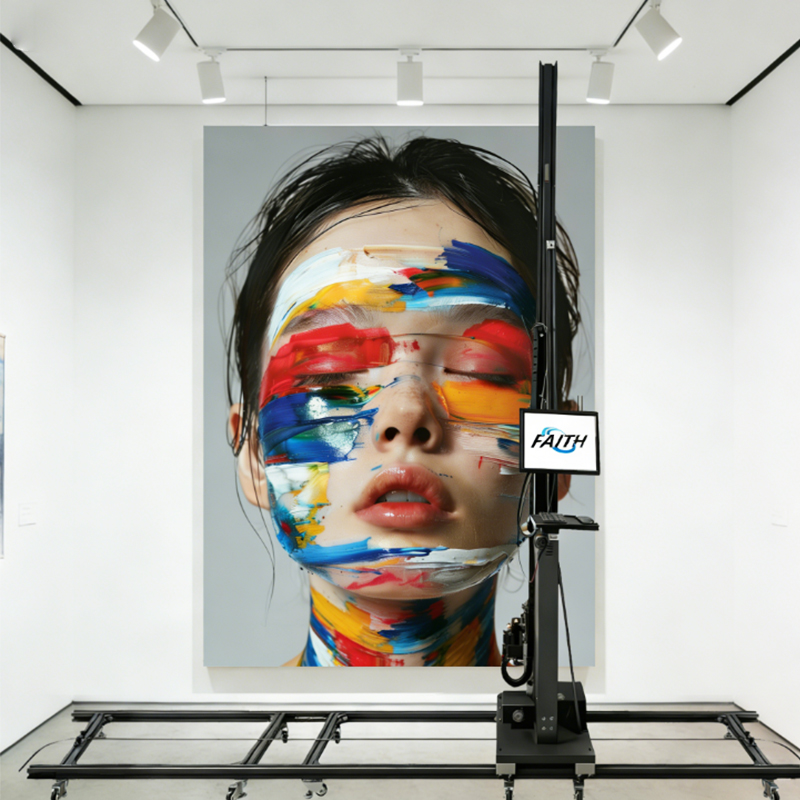
From personalized customization of home feature walls to brand image display in commercial spaces, from digital replication of ancient architectural murals to the rapid presentation of large-scale art installations, wall printers, with their 1:1 reproduction technology, are breaking the limitations of traditional hand-painting, accurately replicating digital patterns onto physical walls, achieving a perfect fusion of artistic expression and practical needs. This technology not only restructures the production model of wall decoration but also achieves breakthroughs in precision control, color reproduction, and scene adaptation.
The 1:1 reproduction of wall printers is not simply a matter of size replication, but a complete technical system encompassing data acquisition, algorithm processing, and precise output. Its core support stems from the dual empowerment of hardware upgrades and software optimization.
Precise positioning and size adaptation technology are the foundation of 1:1 reproduction. In traditional wall decoration, manual scaling of patterns easily leads to problems such as proportional imbalance and edge misalignment. Wall printers, through a laser positioning system and an automatic lifting platform, can accurately detect the flatness of the wall surface (deviation ≤3mm/2m) and automatically adjust the distance between the printhead and the wall (maintaining an optimal range of 3-5mm), ensuring that the printing area perfectly matches the wall size. For extra-large wall surfaces, the equipment supports segmented splicing printing. With millimeter-level positioning accuracy (splitting deviation ≤1mm), it achieves seamless integration of the overall pattern, truly realizing a 1:1 size reproduction that is exactly what you see. Simultaneously, through a multi-dimensional adaptive page matching algorithm, the equipment can automatically convert digital images to the wall coordinate system, solving size adaptation problems without manual intervention and significantly improving construction efficiency.
High-precision inkjet printing and detail rendering capabilities determine the reproduction quality. Mainstream wall printers use piezoelectric nozzles (such as the DX7 and I3200 models), which can precisely control tiny ink droplets of 3-5pl, avoiding brush marks and graininess reminiscent of hand-painted designs, ensuring clear and discernible details. Regarding resolution control, the equipment can adjust parameters according to scene requirements. For close-view scenarios such as home decorations, 300-600 DPI is selected to ensure accurate reproduction of fine details such as flower veins and human hair; for long-view scenarios such as commercial exterior walls, 150-300 DPI is selected to improve printing efficiency while maintaining visual quality. This precise ink droplet control technology enables wall printers to reproduce the gradations and textural details of digital patterns, even surpassing the expressive power of hand-painting.
Compared to traditional hand-painting, wall printers offer significant advantages in efficiency, accuracy, and cost. Hand-painting is limited by the artist's skill, making it difficult to achieve precise proportions for large-format patterns, resulting in significant color mixing errors, long production times, and high labor costs. Wall printers, on the other hand, can operate 24/7, printing on a 100-square-meter wall in just a few hours, and avoid the irreversible errors of hand-painting. Printing errors can be corrected by repainting, reducing waste. Furthermore, the equipment supports both personalized customization and mass production, enabling the creation of unique feature walls for individual homes and the rapid completion of standardized decorations for chain stores, thus reshaping the industry ecosystem of wall decoration.
With continuous technological iteration, the 1:1 reproduction capability of wall printers is constantly being upgraded, extending from single-plane printing to 3D stereoscopic reproduction, and expanding from indoor scenes to outdoor UV-resistant and waterproof scenarios. In the future, with breakthroughs in material technology and algorithm optimization, wall printers will achieve higher-precision color reproduction and more complex texture replication, playing a greater role in fields such as architectural decoration, cultural heritage, and commercial display, making the integration of digital creativity and physical space more seamless and natural.