
 EN
EN
 AR
AR
 HR
HR
 NL
NL
 FR
FR
 DE
DE
 IT
IT
 JA
JA
 KO
KO
 PL
PL
 PT
PT
 RO
RO
 RU
RU
 ES
ES
 SV
SV
 ID
ID
 TH
TH
 TR
TR
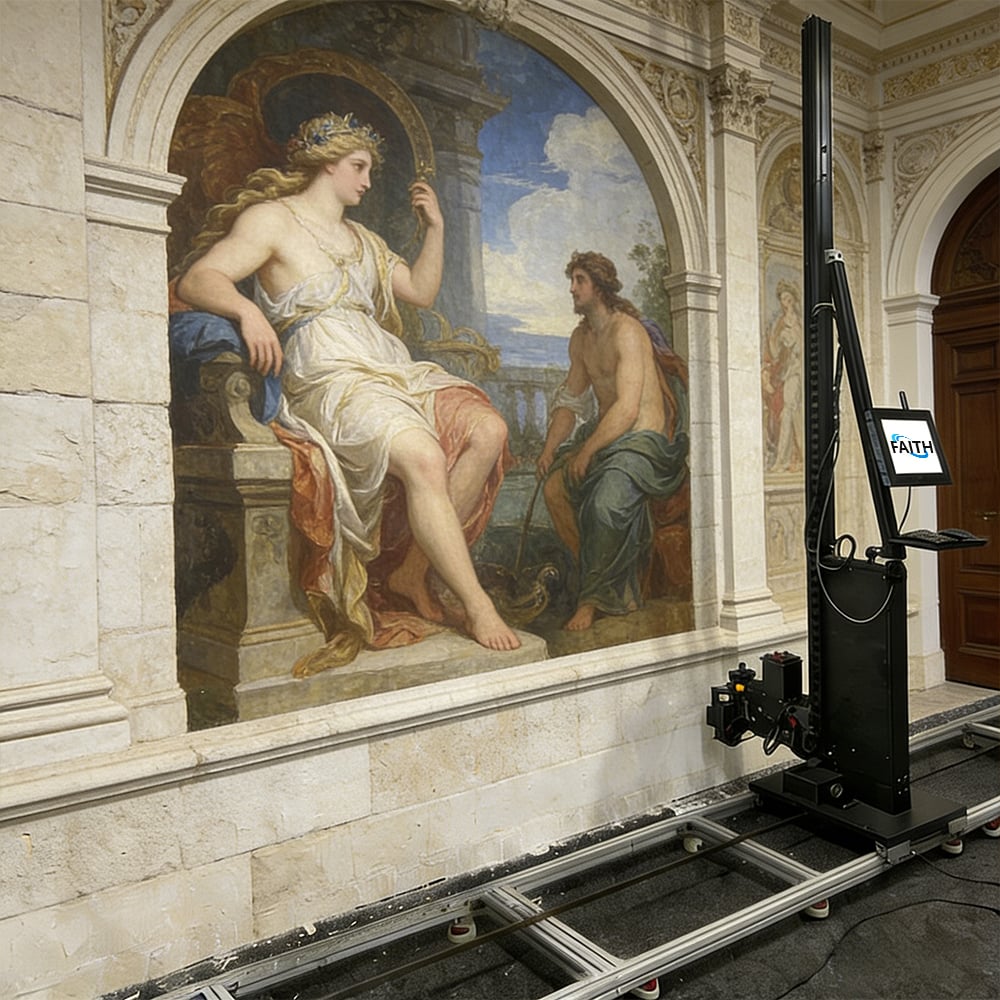
As wall printers become increasingly popular in home decoration, commercial interiors, and public art projects, one common question often arises:
Why doesn’t wall printing fade or get wiped off after printing directly on the wall?
Compared with wallpaper, wall decals, or traditional paint, wall printing looks like it is simply “sprayed” onto the surface. However, in daily use, the printed images remain durable, colorfast, and resistant to light abrasion. This article explains the technical reasons behind this from the perspectives of ink technology, curing process, adhesion mechanism, and wall surface structure.
1. The Key Reason: UV-Curing Ink Technology
The primary reason wall prints are not easily wiped off is that wall printers use UV (ultraviolet) curing ink, rather than traditional water-based ink or ordinary pigments.
How UV Ink Differs from Conventional Ink
- Conventional ink: dries naturally through evaporation or absorption
- UV ink: instantly solidifies through a photochemical reaction under ultraviolet light
Wall printers are equipped with UV lamps positioned near the print head. As soon as the ink is sprayed onto the wall, it is exposed to UV light and instantly transforms from a liquid into a solid polymer layer.
This “print and cure instantly” process significantly enhances durability and adhesion.
2. Ink Is Not Just on the Surface — It Integrates with the Wall Texture
Most wall surfaces are not perfectly smooth at a microscopic level.
Common wall materials such as:
- Painted walls
- Cement or putty walls
- Diatomaceous earth and textured decorative coatings
contain microscopic pores and surface textures.
Adhesion Mechanism of Wall Printing
- UV ink droplets are sprayed at high speed
- Ink penetrates micro-pores on the wall surface
- UV curing locks the ink in place instantly
- A combination of mechanical bonding and chemical solidification is formed
As a result, the ink is not merely sitting on the surface but becomes physically anchored into the wall structure, making it resistant to wiping.
3. Instant Curing Prevents Smearing and Easy Removal
Traditional paint or pigment remains vulnerable before it fully dries:
- It can smear
- It can be wiped away
- It is easily damaged by contact
Wall printers eliminate this issue because UV curing occurs in less than 0.1 seconds. The ink has virtually no time to move or be disturbed.
This is why:
- The image does not smear when touched
- Light friction leaves no marks
- Edges remain sharp and clear
immediately after printing.
4. UV Ink Forms a Highly Durable Protective Layer
Once fully cured, UV ink forms a dense and stable solid film with excellent physical properties:
- Waterproof and moisture-resistant
- UV-resistant and colorfast
- Resistant to light scratching
- Insoluble in water and common cleaning agents
Under normal indoor conditions, printed wall images remain clear and intact even with routine cleaning or daily contact.
5. Influence of Different Wall Materials on Durability
While wall printing is highly durable overall, adhesion performance may vary slightly depending on the wall material:
- Cement or putty walls: very strong adhesion
- Painted walls: stable and suitable for interior decoration
- Textured or diatomaceous walls: excellent ink penetration
- Smooth surfaces such as tiles or glass: usually require white ink or primer for optimal adhesion
Professional wall printers typically support white ink base printing, ensuring reliable results even on smooth or dark surfaces.
6. Why Wall Prints Are Hard to Wipe Off but Still Removable
It is important to clarify that wall printing is durable, but not permanently irreversible.
While the image cannot be removed by wiping with water or cleaning cloths, it can be changed through proper methods:
- Light sanding to break the ink layer
- Applying one or two coats of primer
- Restoring the wall to a blank, repaintable surface
This balance makes wall printing suitable for long-term decoration while still allowing future design changes.
7. Summary: Why Wall Printing Is So Durable
Wall prints are not hard to wipe off because the ink is “thicker,” but because:
- UV-curing ink technology is used
- Ink solidifies instantly upon contact
- Ink penetrates wall micro-textures
- A waterproof, abrasion-resistant solid film is formed
These combined factors make wall printing a durable, professional, and modern wall decoration solution.
Table of Contents
- 1. The Key Reason: UV-Curing Ink Technology
- 2. Ink Is Not Just on the Surface — It Integrates with the Wall Texture
- 3. Instant Curing Prevents Smearing and Easy Removal
- 4. UV Ink Forms a Highly Durable Protective Layer
- 5. Influence of Different Wall Materials on Durability
- 6. Why Wall Prints Are Hard to Wipe Off but Still Removable
- 7. Summary: Why Wall Printing Is So Durable